
Beyond Competence: Why Critical Thinking Is the Capability Multiplier
Building the judgement needed to navigate complexity, ambiguity, and pressure.

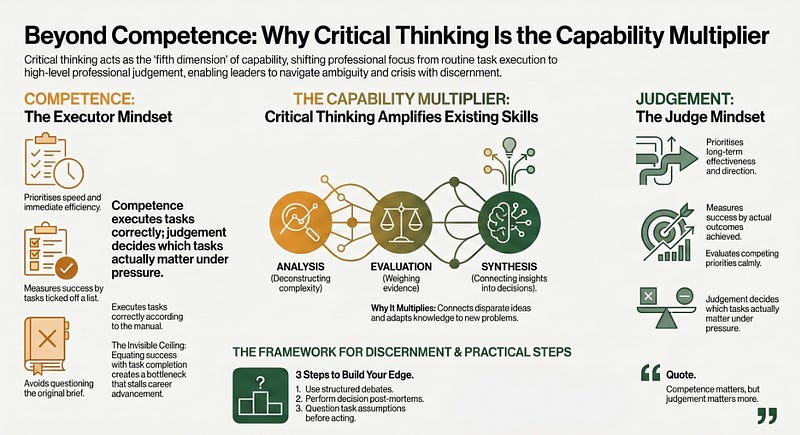
Competence gets you the job, but judgement earns you a seat at the table. Discover how critical thinking acts as a capability multiplier to help leaders navigate ambiguity, pressure, and complex decisions.
In an organisation I worked with, we hired brilliant technicians. They knew the manuals inside out. They executed tasks flawlessly every single day.
But when a crisis hit, the manuals became useless. The rules disappeared overnight. These smart professionals froze because they waited for instructions.
I noticed this pattern repeatedly throughout my career. Competence gets you through the door. It helps you clear your inbox efficiently.
But task execution creates an invisible ceiling. True capability requires professional judgement. It requires deciding what needs doing when nobody tells you.
Key Takeaways
The hidden ceiling: Baseline competence completes tasks, but professional judgement dictates which tasks actually matter.
The multiplier effect: Critical thinking does not replace your existing skills; it actively amplifies them under pressure.
The human advantage: As automation handles routine work, human discernment becomes your most protected professional asset.
The Competence Trap
Why do smart people fail when ambiguity strikes? They fail because they rely entirely on baseline competence. Baseline competence means doing exactly what is asked.
In a shifting workplace, technical skills expire quickly. If you only know how to execute, you become obsolete.
Equating success with task completion builds a trap. It limits your ability to handle unstructured problems. This mindset bottleneck will eventually stall your career advancement.
What is the difference between competence and judgement? Competence is getting things done. Judgement is deciding what actually needs doing.
Signs you are stuck in the competence trap:
Waiting for explicit instructions before acting.
Focusing purely on the volume of work completed.
Feeling paralysed when standard procedures fail.
Making the mindset shift:
Stop asking, ‘How do I do this?’.
Start asking, ‘Why are we doing this?’.
Question the premise of the task itself.
Critical Thinking as the Capability Multiplier
Critical thinking does not replace your existing skills. It acts as a capability multiplier. It amplifies everything else you know.
Because it connects disparate ideas, you apply knowledge flexibly. You adapt old information to solve entirely new problems.
This requires a shift from doing the work to evaluating the work. You must step back and observe the wider context.
Intellectual humility plays a massive role here. The best thinkers actively challenge their own assumptions. They invite thoughtful dissent from their peers.
Characteristics of a capability multiplier:
Synthesises conflicting information quickly.
Adapts old knowledge to new problems.
Finds hidden patterns that others miss.
How intellectual humility changes your approach:
You actively look for flaws in your logic.
You invite opposing opinions from your peers.
You admit when a strategy stops working.
Execution vs. Judgement: The Core Difference
There is a big difference between doing things right and doing the right things. Executors focus entirely on the ‘how’. Judges focus on the ‘why’.
Organisations pay a premium for judgement. Execution is cheap and easy to find. Strategic direction is rare.
Professional judgement requires strict emotional regulation. You must step back from cognitive traps to evaluate competing priorities calmly.
Industry reports from Deloitte and LinkedIn confirm this shift. Emotional intelligence and critical thinking are now power skills. They drive organisational resilience.
The executor mindset:
Prioritises speed and immediate efficiency.
Avoids questioning the original brief.
Measures success by tasks ticked off a list.
The judge mindset:
Prioritises long-term effectiveness and direction.
Evaluates competing priorities calmly.
Measures success by actual outcomes achieved.
Navigating Ambiguity and High-Pressure Environments
High-stakes environments demand choices with incomplete data. You rarely have all the facts before you must act.
Reactive leaders panic in these moments. They rely on sheer instinct when data is missing.
Critical thinkers stay proactive. They use clear frameworks for decision agility. They separate facts from assumptions immediately.
They apply second-order thinking. They focus on downstream consequences, not just the immediate fix.
Dissecting a high-pressure situation:
Identify what you know for absolute certain.
List the assumptions you are currently making.
Test those assumptions against reality quickly.
Applying second-order thinking:
Ask what happens after the immediate fix.
Consider the effect on team morale.
Anticipate new problems your solution might create.
The AI Factor: Why Discernment is Future-Proof
Artificial Intelligence automates routine tasks. It processes raw data instantly. This makes human judgement your most protected asset.
AI accelerates the need for human discernment. It does not replace it. We need people who can interpret the outputs.
You must become a leader as editor. You direct strategy rather than generating content from scratch.
Because ethical decision-making is uniquely human, we must validate automated answers. We must challenge machine logic with human context.
The shift in daily work:
Less time spent gathering raw data.
More time spent interpreting that data.
Heavy focus on verifying accuracy and context.
The role of the strategic editor:
Frames the right questions for AI tools.
Applies ethical reasoning to generated answers.
Aligns outputs with organisational values.
Conclusion: Cultivating Your Inner Judgement
Competence gets you hired. Judgement makes you indispensable.
Authentic growth comes from developing inner discernment. It is not about chasing external achievements.
You must audit your own decision-making processes. Look closely at how you handle unexpected problems.
Are you stuck in the competence trap? Or are you actively cultivating your judgement edge?
Questions for your self-audit:
Do I question the premise of my tasks?
How do I react when the rules disappear?
Am I anticipating the next problem?
Steps to build your judgement edge:
Pause before reacting to urgent requests.
Seek out projects with unclear guidelines.
Extract lessons via learning from failure.
Wrapping Up
Building your judgement takes time. It requires patience and a willingness to sit with discomfort. Start small. Question the next routine task you receive. Ask yourself if it actually moves the needle.
Your Turn
What is one recent task you completed flawlessly that, upon reflection, you probably did not need to do at all?
🌱 The Growthenticity Connection
The core ideas discussed in this article aren’t just isolated concepts; they deeply resonate with the principles of what I call ‘Growthenticity’:
“The continuous, integrated process of becoming more oneself (authentic) through leading with questions, learning through action, and growing by embracing uncertainty and imperfection, all fuelled by curiosity.”
Cultivating judgement is an act of embracing uncertainty. When we step away from the safety of checklists, we face the unknown. This forces us to lead with questions rather than assuming we have all the answers.
Developing this capability multiplier fuels our curiosity. We stop accepting tasks at face value. We start learning through action, refining our discernment with every imperfect decision we make.
This article explores how self-awareness, emotional regulation, and psychological maturity create a real professional edge. It explains why inner work shapes leadership effectiveness under pressure and shows how these ideas connect to the broader principles behind my article, The Growthenticity Ecosystem™: A Master Framework for Modern Professionals.
The Growthenticity Ecosystem™: A Master Framework for Modern Professionals

Built around three connected pillars — THRIVE, IMPACT, and CLARITY — this framework helps professionals lead themselves well, build real capability, and lead others with maturity and adaptability.
Thanks for reading...
If you enjoyed reading/listening to my story, please like and share any parts you think other readers would find interesting.
Don’t forget to leave your comments about what you thought of this story.
Consider following me here on Substack and subscribing to my stories.
📋 Get the insight for free. Get the full implementation system as a paid subscriber
Subscribe to Lead, Learn, Grow for practical ideas on leadership, learning, and professional growth. Free subscribers get key insights and community connection; paid subscribers get full articles, audio, and subscriber-only tools to apply the ideas in real life.
Free subscriber
Weekly previews and core insights.
Community connection and discussion.
Paid subscriber
✅ Full access to every article.
✅ Subscriber-only workbooks with step-by-step exercises.
✅ Audio versions for learning on the go.
✅ 2-week early access before articles appear elsewhere.
✅ Priority engagement and deeper implementation support.
If the free post helps you think, the paid tier helps you apply.
Subscribe to Lead, Learn, Grow
Here is some information about me and how to connect with me on different platforms.
🤿 Ready to move beyond the fundamentals and dive deeper?
Upgrade now to get the complete implementation system for this article’s topic—plus the tools and support to make it work for you.
--- 🔒 PAYWALL: UPGRADE TO READ THE REST ---
