
Beyond Compliance: Leading Through AI’s Ethical and Social Impact
Why ethical leadership matters more than ever in an AI-shaped world.

A while ago, I worked with an organisation that approved an automated tool to sort through candidate resumes. We thought it would speed up hiring. Within weeks, I noticed a troubling pattern. The tool systematically rejected applicants with non-traditional career paths.
I felt responsible for consequences I did not foresee. We had to pause it right away. We then reviewed our entire approach. This situation forced us to confront uncomfortable questions about fairness and power.
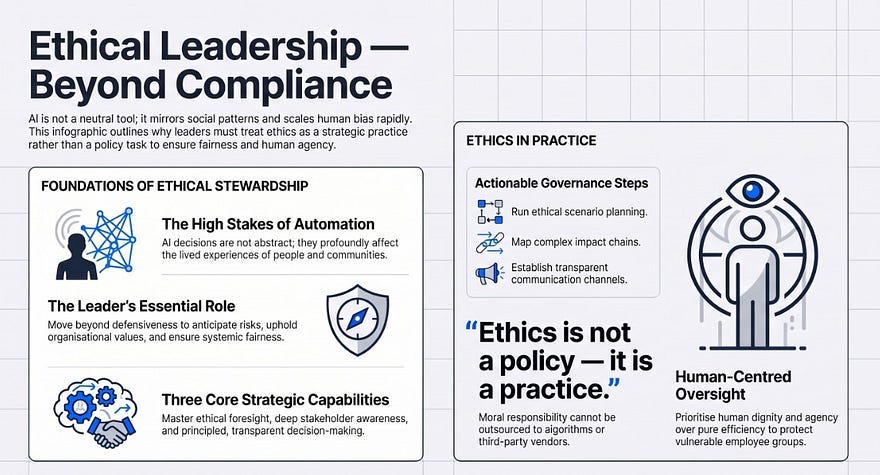
Facing these ethical uncertainties requires quiet confidence. Leaders must tackle these issues without defensiveness. AI ethics is not abstract philosophy. It is the lived experience of people affected by automated decisions.
Key Takeaways
Social amplification: AI amplifies existing social inequalities if left unchecked.
Proactive ownership: Ethical leadership requires proactive, not reactive, judgement.
Human consequences: Leaders must understand the human impact of AI decisions.
Strategic capability: Ethics is a strategic capability, not a compliance task.
The Social Impact of AI — Who Benefits and Who Doesn’t
AI reshapes society in uneven ways. It creates advantages for some and barriers for others.
Here is how AI changes the social fabric:
Unequal access to advanced AI tools.
Automation pressures on specific administrative roles.
Power concentration in large technology platforms.
Social stratification through algorithmic decision-making.
Because AI affects groups differently, we need empathy in leadership. You must understand the lived reality of your team.
Consider these realities:
AI is not a neutral system.
It reflects the values of its creators.
It scales human biases rapidly.
The Ethical Challenges Leaders Must Understand
We must understand the limits of these tools. We can approach this by learning through analogy. AI is a mirror reflecting social patterns, not a mind understanding them. Ethical clarity requires understanding the limits of automated intelligence.
1. Fairness
Bias in training data.
Unequal outcomes for minority groups.
Systemic disadvantage scaled by speed.
2. Transparency
Understanding how decisions happen.
Explaining the logic behind an outcome.
Making hidden processes visible.
3. Accountability
Identifying who holds responsibility.
Addressing harm caused by automation.
Correcting system errors quickly.
4. Privacy
Protecting sensitive personal data.
Respecting human dignity above efficiency.
Limiting unnecessary surveillance.
5. Autonomy
Ensuring AI supports human agency.
Preventing algorithms from replacing human choice.
Keeping humans in control.
The Leadership Responsibilities That Can’t Be Delegated
You can’t outsource moral responsibility to an algorithm. True authentic leadership shows in behaviour, not corporate statements.
Hold these specific responsibilities:
Setting clear ethical guardrails.
Ensuring human-in-the-loop oversight.
Evaluating downstream social consequences.
Protecting vulnerable employee groups.
Making values-based deployment decisions.
Delegation fails in these areas because:
Algorithms lack moral reasoning.
Vendors do not share your reputational risk.
Compliance does not equal ethics.
Practical Steps to Lead Ethically With AI
Ethical leadership is a daily practice. It requires structural changes to how you work.
Take these actionable steps:
Run ethical impact assessments before deployment.
Create cross-functional ethics reviews for high-risk decisions.
Document ethical reasoning to build transparency.
Educate teams on fairness and bias.
Engage diverse voices to challenge blind spots.
To make this work, you must build the right culture:
Reward healthy workplace debate.
Accept that ethical clarity emerges through challenge, not consensus.
Encourage teams to question automated outputs.
Grow Authentically in the AI Era
Ethical leadership requires humility and courage. AI forces us to confront deep questions about fairness and power. Growth comes from engaging with this complexity. We must not avoid the hard questions.
Focus your energy here:
Prioritise curiosity over certainty.
Choose responsibility over convenience.
Value human dignity over pure efficiency.
Wrapping Up
AI offers immense analytical power. But power requires strict human oversight. Leaders must step up and take ownership of the outcomes. Ethics can’t be an afterthought. It must be the foundation of your technological choices.
🌱 The Growthenticity Connection
The core ideas explored in this article aren’t just isolated concepts. They deeply resonate with the principles of what I call ‘Growthenticity’:
‘The continuous, integrated process of becoming more oneself (authentic) through leading with questions, learning through action, and growing by embracing uncertainty and imperfection, all fuelled by curiosity.’
Questioning algorithmic outputs aligns perfectly with leading with questions. When we test AI tools and learn from their flaws, we learn through action. We do not need perfect systems to start.
Facing the ethical ambiguity of new technology means embracing uncertainty. Curiosity drives us to understand how these tools actually affect real people. This keeps us grounded in human values.
What This Article Explores
This article examines the deeper ethical and social implications of AI. It covers aspects like fairness, transparency, accountability, privacy, and autonomy. It also discusses how leaders can navigate these challenges with integrity. The article ties into the broader ideas in my full article, Ethical and Social Implications of AI. In that article, I explore these concepts in greater depth. I also provide real-world examples of ethical leadership.
Ethical and Social Implications of AI – Nomad Learning
Your Turn
What ethical question about AI do you think your organisation has not yet asked — but should?
Thanks for reading...
If you enjoyed reading/listening to my story, please like and share any parts you think other readers would find interesting.
Don’t forget to leave your comments about what you thought of this story.
Consider following me here on Substack and subscribing to my stories.
References & Further Reading
These sources deepen the article’s core argument: leaders must understand the ethical and social implications of AI to lead responsibly.
Bender, E., Gebru, T., McMillan‑Major, A., & Shmitchell, S. (2021). On the Dangers of Stochastic Parrots. Association for Computing Machinery (ACM).
(Explains how large language models can reinforce bias, misinformation, and systemic inequities. Reinforces the article’s emphasis on fairness, transparency, and responsible leadership.)Floridi, L. (2019). The Logic of Information. Oxford University Press.
(Explores the philosophical foundations of AI ethics — autonomy, dignity, agency — aligning with the article’s focus on values‑based leadership and reflective judgement.)Stanford Institute for Human‑Centered AI (Annual). AI Index Reports. Stanford University.
(Provides data‑driven insights into AI’s societal, economic, and geopolitical impact. Supports the article’s themes of power, inequality, and the social consequences of AI adoption.)
📋 Get the insight for free. Get the full implementation system as a paid subscriber
Subscribe to Lead, Learn, Grow for practical ideas on leadership, learning, and professional growth. Free subscribers get key insights and community connection; paid subscribers get full articles, audio, and subscriber-only tools to apply the ideas in real life.
Free subscriber
Weekly previews and core insights.
Community connection and discussion.
Paid subscriber
✅ Full access to every article.
✅ Subscriber-only workbooks with step-by-step exercises.
✅ Audio versions for learning on the go.
✅ 2-week early access before articles appear elsewhere.
✅ Priority engagement and deeper implementation support.
If the free post helps you think, the paid tier helps you apply.
Subscribe to Lead, Learn, Grow
Here is some information about me and how to connect with me on different platforms.
🤿 Ready to move beyond the fundamentals and dive deeper?
Upgrade now to get the complete implementation system for this article’s topic—plus the tools and support to make it work for you.
--- 🔒 PAYWALL: UPGRADE TO READ THE REST. ---
