
The Slow Down Strategy: Inviting Better Thinking for Smarter Decisions
Encouraging diverse perspectives and healthy debate in a rush-to-action world.

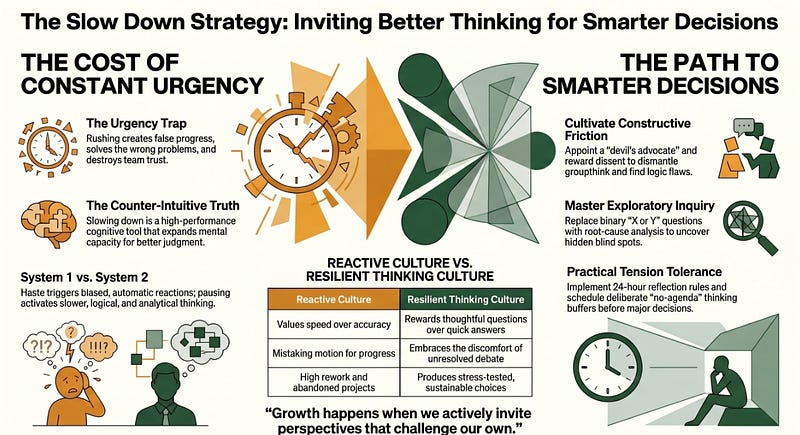
Rushed choices destroy trust and waste resources. Discover how adopting the strategic pause and inviting constructive debate leads to smarter, more resilient organisational decisions.
I remember working on a project where we rushed a software rollout. We skipped testing to meet an arbitrary deadline. The system crashed on day one. We spent weeks fixing mistakes we could have avoided.
This taught me a hard lesson about speed. When we move too fast, we stop thinking. We act on impulse because silence feels uncomfortable. We choose the illusion of progress over actual results.
I realised we needed a different approach. I started forcing my teams to pause before acting. This intentional delay improved our outcomes. Because we slowed down, we finally started making smart choices.
Key Takeaways
The urgency trap: Rushing decisions creates false progress and destroys team trust.
The strategic pause: Delaying action allows logical thinking to replace emotional reactions.
Constructive friction: Inviting disagreement prevents groupthink and reveals hidden blind spots.
The Cost of the Urgency Trap
‘How often do we mistake sheer motion for actual progress?’
In an organisation I worked with, motion equated to value. We suffered from an undeniable urgency addiction. We acted quickly because uncertainty caused physical discomfort. This rush-to-action mentality damages long-term goals.
I noticed a shift away from ‘fail fast’ cultures. Teams now prefer deliberate execution over reckless speed. Because rushed choices fail, we must adopt strategic patience.
The fallout of moving too fast includes:
Solving the wrong problems entirely.
Wasting budgets on superficial fixes.
Eroding trust within the working group.
The cultural shift towards patience requires:
Valuing accuracy over sheer speed.
Rewarding thoughtful questions over quick answers.
Accepting the discomfort of not knowing immediately.
‘When did a rushed decision cost our team more time and trust in the long run?’
The Neuroscience of Slowing Down
I learned that our brains betray us under pressure. We rely on two distinct systems for decision making.
Here is how our thinking breaks down:
System 1 is fast, automatic, and highly biased.
System 2 is slower, analytical, and highly logical.
When we rush, we default to System 1. Therefore, we make predictable, avoidable errors. Slowing down expands our mental capacity. It reduces cognitive load and prevents poor choices.
I tested what I call the ‘cheetah pause’. Before striking, a cheetah surveys the entire horizon. Leaders who pause project a calming presence.
This deliberate stillness offers several benefits:
It reassures teams during high-stakes situations.
It creates space to manage volatility.
It signals confidence rather than panic.
Three Steps to Invite Better Thinking
Step 1: The Strategic Pause
I struggled with reactive execution early in my career. I changed my approach by building deliberate buffers into schedules. We stopped making high-stakes choices in the room. Instead, we practised tension tolerance.
Tension tolerance requires executive teams to:
Sit comfortably with unresolved debate.
Resist the urge to close the loop immediately.
Let ideas marinate before acting.
Step 2: Cultivating Constructive Dissent
Fast choices usually rely on quick consensus. Because consensus feels safe, it quickly devolves into groupthink. ‘Who in our current team feels the safest challenging the consensus?’
I realised we needed psychological safety to survive. People need oxygen to debate without facing social penalties.
We introduced friction by design using these tactics:
Appointing a designated ‘devil’s advocate’ for every meeting.
Employing ‘red teaming’ exercises to dismantle initial plans.
Rewarding those who found flaws in our logic.
Step 3: The Power of Better Questions
Rushed teams ask binary tactical questions. They ask, ‘Should we do X or Y?’ We tested elevating our enquiry to a higher level. We asked, ‘What problem are we actually trying to solve?’
This root cause analysis changed our entire trajectory. We also implemented ‘pre-mortems’ as a standard operating procedure.
Pre-mortems help teams by:
Exploring potential risks before locking in a decision.
Identifying failure points in a safe environment.
Removing the stigma of questioning the plan.
Artificial intelligence handles routine data synthesis now. Therefore, leaders must ask exploratory questions to facilitate debate. ‘Are we asking questions to confirm our biases, or to genuinely uncover our blind spots?’
The Growthenticity Perspective: Intellectual Humility
I noticed that true leadership growth demands courage. You must pause and let others dismantle your ideas. This requires deep intellectual humility.
We adopted a simple but strict team rule. We were ‘hard on the idea, soft on the person’.
This mantra achieves three specific outcomes:
It depersonalises constructive friction.
It builds deep, authentic trust.
It separates personal ego from project success.
Intellectual humility requires leaders to:
Admit when their initial instinct was wrong.
Publicly praise those who correct their mistakes.
Separate their self-worth from their ideas.
Because we prioritised respectful debate over consensus, we succeeded. Shared brilliance emerges when we abandon comfortable agreement.
These resilient cultures share specific characteristics:
They adapt quickly to unexpected market changes.
They retain independent thinkers who challenge the norm.
They produce smarter, stress-tested organisational choices.
Conclusion: Slowing Down to Speed Up
Resisting the urge to react immediately speeds up execution. I learned that a calculated pause prevents costly rework. It leads to smarter, more resilient organisational decisions.
Slowing down is an active, high-performance trait. It is not a sign of weakness or hesitation.
A deliberate delay provides clear tactical advantages:
It filters out emotional reactions.
It invites diverse perspectives into the room.
It aligns daily actions with long-term strategy.
The long-term effects of this strategy include:
Higher retention of top talent.
Fewer abandoned projects.
Stronger mutual trust across departments.
I challenge you to change your schedule tomorrow. Try implementing a deliberate ‘thinking buffer’ in your calendar.
Here is how you can start immediately:
Block ten minutes before your most critical meeting.
Turn off all notifications during this window.
Write down one assumption you need to test.
Wrapping Up
You cannot rush brilliance. Better thinking requires the courage to sit in silence. When you slow down, you finally see the whole board.
Your Turn
What is one recurring problem in your team that might disappear if you simply waited 24 hours before trying to solve it?
🌱 The Growthenticity Connection
The core ideas explored in this article aren’t just isolated concepts; they deeply resonate with the principles of what I call ‘Growthenticity’:
“The continuous, integrated process of becoming more oneself (authentic) through leading with questions, learning through action, and growing by embracing uncertainty and imperfection, all fuelled by curiosity.”
Slowing down forces us to embrace uncertainty. When we pause, we admit we do not have all the answers. This vulnerability aligns perfectly with authentic self-discovery.
Because we lead with better questions, we invite genuine curiosity. This curiosity dismantles our ego and fuels continuous growth.
This article explores how slowing down helps leaders think more clearly, question assumptions, and make better decisions under pressure. It connects a strategic pause, honest challenge, and intellectual humility to the broader principles behind my article, The Growthenticity Ecosystem™: A Master Framework for Modern Professionals.
The Growthenticity Ecosystem™: A Master Framework for Modern Professionals

Built around three connected pillars — THRIVE, IMPACT, and CLARITY — this framework helps professionals lead themselves well, build real capability, and lead others with maturity and adaptability.
Thanks for reading...
If you enjoyed reading/listening to my story, please like and share any parts you think other readers would find interesting.
Don’t forget to leave your comments about what you thought of this story.
Consider following me here on Substack and subscribing to my stories.
📋 Get the insight for free. Get the full implementation system as a paid subscriber
Subscribe to Lead, Learn, Grow for practical ideas on leadership, learning, and professional growth. Free subscribers get key insights and community connection; paid subscribers get full articles, audio, and subscriber-only tools to apply the ideas in real life.
Free subscriber
Weekly previews and core insights.
Community connection and discussion.
Paid subscriber
✅ Full access to every article.
✅ Subscriber-only workbooks with step-by-step exercises.
✅ Audio versions for learning on the go.
✅ 2-week early access before articles appear elsewhere.
✅ Priority engagement and deeper implementation support.
If the free post helps you think, the paid tier helps you apply.
Subscribe to Lead, Learn, Grow
Here is some information about me and how to connect with me on different platforms.
🤿 Ready to move beyond the fundamentals and dive deeper?
Upgrade now to get the complete implementation system for this article’s topic—plus the tools and support to make it work for you.
--- 🔒 PAYWALL: UPGRADE TO READ THE REST ---
